



|
Getting your Trinity Audio player ready...
|
People like to compare gold and cash, but they often get stuck on short-term price swings and miss the bigger question: what can each really buy years from now? In the last decade, the U.S. dollar lost about 26% of its purchasing power to inflation, while gold roughly doubled its real buying power after you factor in rising prices.
Look at longer spans—20 or 30 years—and the numbers get even more dramatic.
The gap between cash and gold really comes down to how each handles inflation. Cash just sits there as prices go up, so every dollar buys less as time passes.
Gold, meanwhile, usually rises in value when inflation heats up. Of course, it’s a bumpy ride—gold’s price jumps around a lot more than cash.
Thinking about purchasing power over decades can help investors figure out how to protect what they’ve worked for. The data shows patterns in how gold and cash behave under different economic conditions, from steady growth to wild inflation or turbulence.
How Inflation Impacts Gold and Cash Purchasing Power

Inflation directly shapes what your money can buy in the future. The dollar keeps losing value over time, while gold often holds steady or even grows its purchasing power when prices rise.
The Erosion of the Dollar Over Time
Inflation pushes prices up year after year, so cash loses purchasing power. A dollar today just doesn’t go as far as it did ten years ago—that’s been the pattern for a long time.
Between 2014 and 2024, with inflation averaging around 3% per year, $100 shrank to about $74 in real terms. You’d need about $134 in 2024 to buy what cost $100 in 2014.
When inflation really takes off, the erosion speeds up. In the 1970s, inflation averaged over 6% annually, and cash holders saw their buying power cut almost in half over the decade.
Money sitting in a savings account or under your mattress just loses value—there’s really no way around it. Even so-called “stable” 2% inflation adds up. Over 30 years, a dollar keeps only about 55% of its buying power. That’s why cash is a pretty lousy store of value for the long haul.
Measuring Real Returns: Adjusting for Inflation
Real returns tell you the truth about your wealth—they subtract inflation from your gains. That’s how you see if you’re actually ahead or just treading water.
The formula’s simple: real return equals nominal return minus inflation. If gold goes up 5% in a year and inflation is 3%, your real return is just 2%.
People who ignore inflation often think they’re making money when they’re really not. For example, a savings account earning 1% interest during a 3% inflation year actually loses 2% in real buying power.
Gold’s real returns jump around a lot from decade to decade. In the 1970s, gold soared as inflation crushed cash. But in the 1980s and 1990s, when inflation cooled off, gold’s real returns were negative.
Gold’s Historical Performance in Inflationary Periods
Gold acts as an inflation hedge mostly when money gets unstable or prices really start to climb. Its performance ties more to the broader economic backdrop than just inflation alone.
The 1970s show gold at its inflation-fighting best. After Nixon ditched the gold standard in 1971 and oil shocks hit, gold prices exploded—up nearly 20 times in that decade.
In recent years, the story’s mixed. From 2020 to 2024, gold broke $2,000 an ounce as pandemic inflation and global tensions rose. Negative real interest rates made cash look unattractive, so more people turned to gold as a store of value.
But not every inflationary spell boosts gold. Between 2008 and 2012, gold doubled even though inflation was only 2-3% per year. Sometimes fear of economic collapse or currency debasement matters more than inflation itself. Context is everything when you’re weighing gold vs cash.
Comparing Gold vs. Cash Over 10, 20, and 30 Years
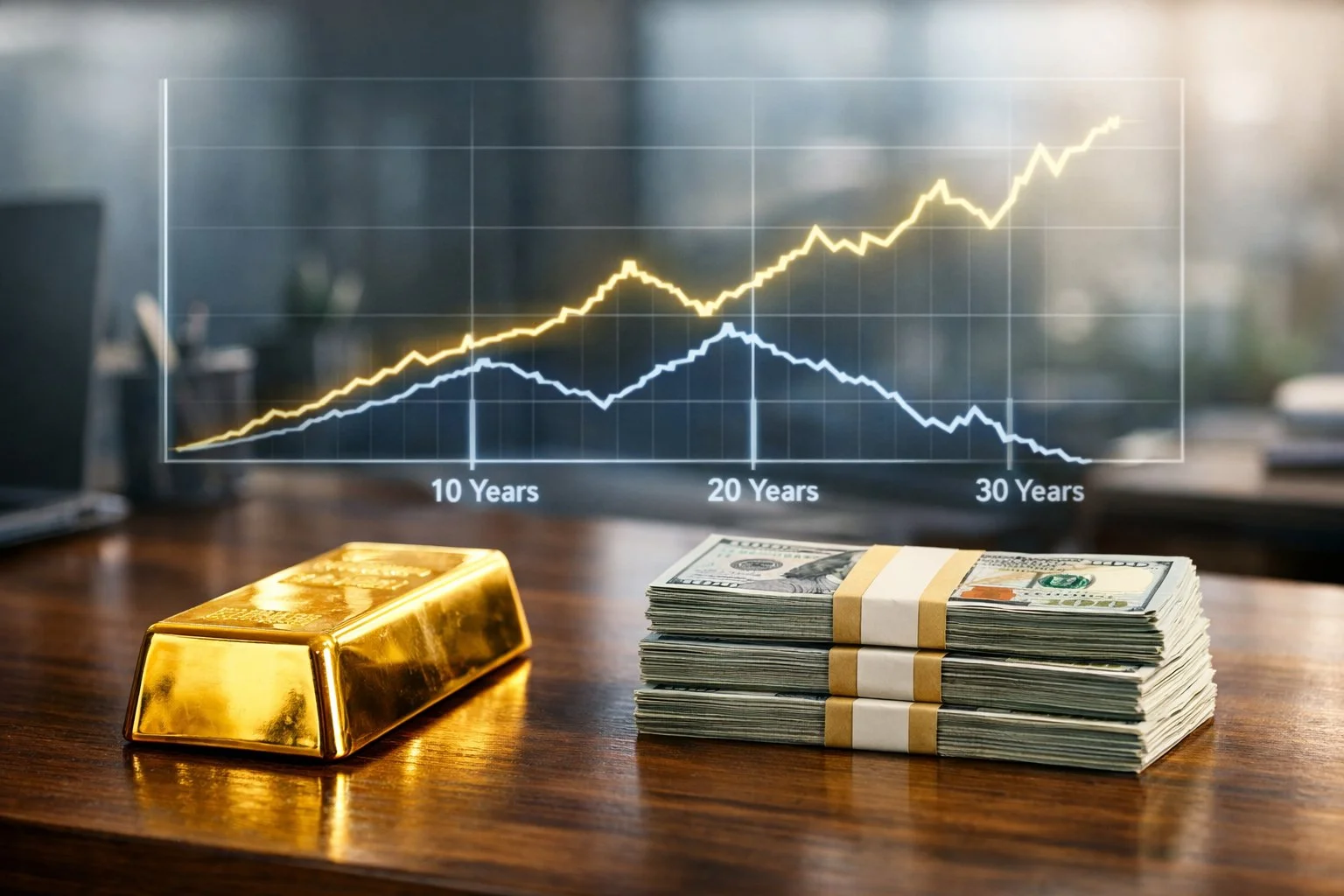
The longer you hold onto cash or gold, the bigger the difference gets. Gold usually keeps or grows its purchasing power, while cash keeps slipping because of inflation.
10-Year Purchasing Power Analysis
Over ten years, cash typically loses 25–30% of its purchasing power if inflation runs at 2.5–3% a year. What costs $100 now would take about $128 after a decade.
If you stash cash in a basic savings account, you’ll watch its real value trickle away. Gold, on the other hand, often increases in dollar terms and keeps up with inflation over the same period.
Here’s what that looks like in practice. Hold $10,000 in cash for ten years, and you’ll still have $10,000—but it’ll only buy what $7,500–$7,800 would have bought at the start. If you’d put that money into gold, odds are you’d at least keep pace with inflation, maybe even come out ahead.
20-Year Real Value Trends
Stretch it to twenty years, and cash loses about 40% of its purchasing power if inflation stays steady at 2.5%. A dollar from two decades ago now needs $1.64 to match its original buying power.
Gold shows stronger wealth preservation over two decades. It does a better job shielding you from currency devaluation than cash sitting in a bank. Even with interest, cash accounts rarely keep up with real inflation.
The numbers make it obvious. Since the early 2000s, gold jumped from around $300 to over $2,000 an ounce. Cash, meanwhile, lost a big chunk of its value despite any interest you might’ve earned. That’s a huge difference in how these assets handle long-term pressure.
30-Year Wealth Preservation Comparison
Three decades of inflation chops cash’s purchasing power by more than half. With 2.5% annual inflation, $100 from thirty years ago now needs about $209 to buy the same stuff. That’s a 52% loss in real value for anyone just sitting on cash.
Gold’s been a more reliable store of wealth across 30-year stretches. Since 1996, it climbed from about $400 an ounce to over $2,000. That’s more than a fivefold increase—way ahead of inflation.
Key differences stand out:
- Cash loses over half its purchasing power
- Gold usually multiplies in dollar value
- Gold wins for long-term wealth preservation
- Cash’s flexibility comes at a real cost
Factors Influencing Long-Term Outcomes
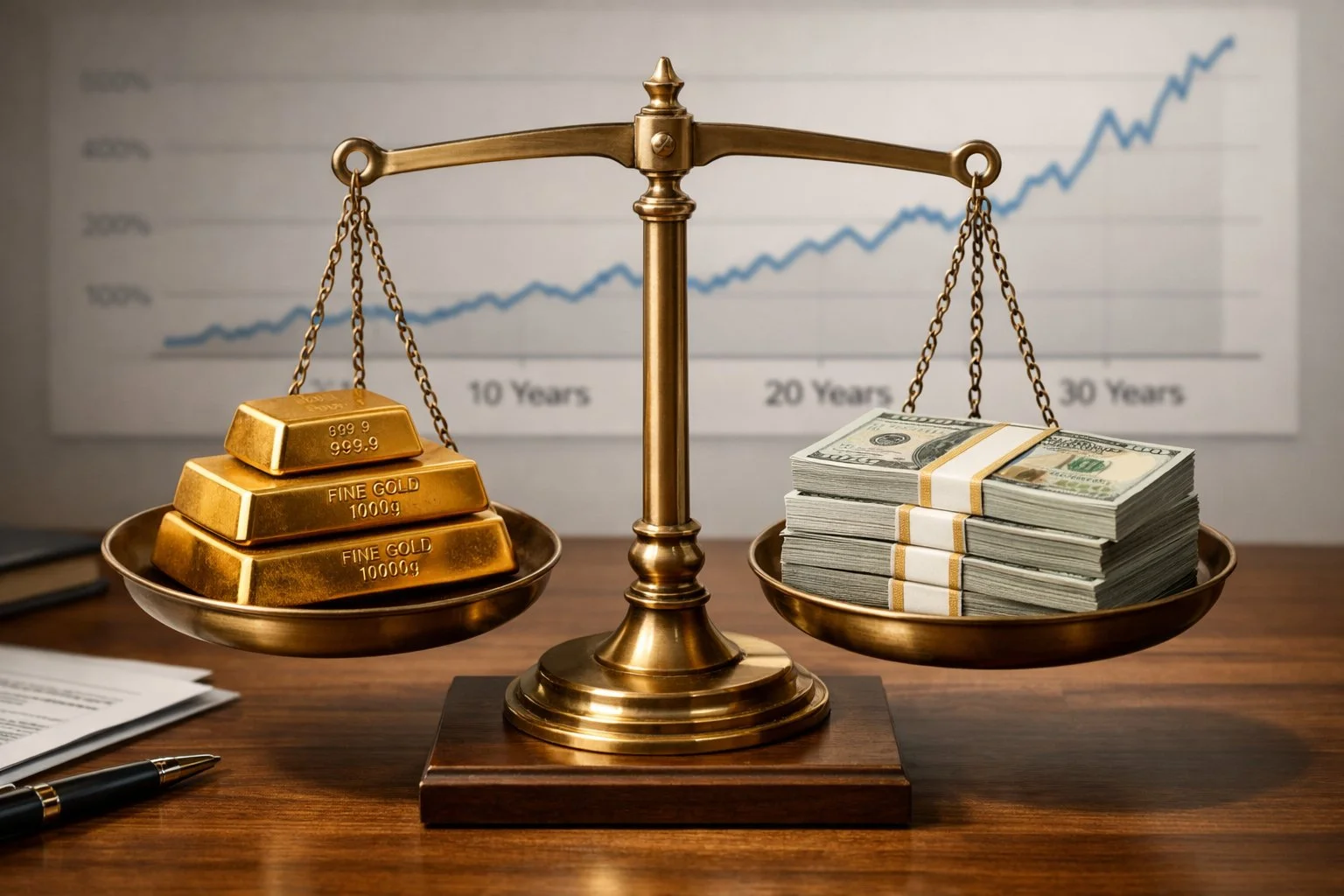
Several big forces shape the tug-of-war between gold and cash. Currency supply, economic shocks, global politics, and central bank moves all play a role in which asset keeps its value over the long run.
Currency Dilution and Money Supply Expansion
When governments crank up the money supply, each dollar loses some of its punch. Central banks do this by printing more money or buying bonds, which pumps credit into the system. Since the 1970s, after the dollar broke from gold, the greenback’s been diluted a lot.
The 2008 financial crisis and the 2020 pandemic saw the U.S. money supply balloon fast. Trillions of new dollars flooded in. More dollars chasing the same goods means higher prices.
What happens when the money supply grows:
- Existing cash loses value
- Consumer prices get pushed up
- Hard assets like gold benefit
- The effect builds over decades
Gold supply, by contrast, grows slowly—just 1–2% a year through mining. That scarcity is a world apart from currency, which governments can create with a pen stroke.
Economic Crises and Financial Instability
Big economic shocks change the balance between gold and cash. The 2008 crisis showed how quickly trust in banks and currencies can evaporate.
In a banking crisis, cash faces some special risks. If banks fail or freeze accounts, you might not get your money when you need it. Gold, though, sits outside that system—it’s got no counterparty risk.
Downturns often force governments to step in with stimulus spending. That usually means more debt and more money in circulation, which chips away at purchasing power. Gold prices often surge during these periods of financial stress.
When markets crash or credit dries up, investors run to assets that feel safe. That pattern keeps repeating, crisis after crisis, throughout modern financial history.
Impact of Geopolitical Events
Wars, trade conflicts, and international tensions shape currency values and gold prices. Political instability in one region can ripple through global markets and shift investment flows between asset classes.
Major geopolitical disruptions include conflicts in the Middle East and trade disputes between big economies. Shifts in global power dynamics also play a role.
These events usually push gold prices higher and create uncertainty around currency values. Sanctions and trade restrictions can crush affected currencies fast.
Nations under international pressure often watch their cash lose value, while gold keeps its global appeal. Gold trades in every major market, no matter the politics.
Currency devaluations often follow political upheaval or policy missteps. People holding that nation’s cash lose purchasing power overnight, but gold owners keep their wealth across borders.
Monetary Policy and Interest Rates
Central banks set interest rates, which directly influence whether it makes sense to hold gold or cash. Higher rates make cash more attractive since savings and bonds pay better returns.
When rates are low, cash loses its edge. That’s when gold starts to look good by comparison.
Interest rate environments:
- High rates (above 5%): Cash pays income, gold pays nothing
- Low rates (below 3%): Cash barely beats inflation, gold gets more appealing
- Negative real rates: If inflation beats interest rates, gold usually wins
The Federal Reserve and other central banks use rate changes to manage inflation and growth. These moves set the stage for how gold and cash compare.
Inflation targeting policies aim for 2-3% annual price increases. That means cash is designed to lose value over time.
Gold acts as a hedge when monetary policy can’t keep inflation in check.
Portfolio Strategies: Balancing Gold and Cash
Most investors do better holding both gold and cash, not just picking one. Cash covers immediate needs and offers flexibility, while gold protects long-term purchasing power if inflation or currency values go sideways.
Diversification and Risk Management
Portfolio diversification spreads risk across different asset types. Gold and cash balance each other because they react differently to economic shifts.
When inflation spikes, cash loses value but gold usually holds steady or rises. In uncertain markets, both can offer some stability.
Financial pros often suggest putting 5% to 18% of a portfolio into precious metals. The right amount depends on your risk tolerance and goals.
Younger folks might stick with less gold since they have time to bounce back from downturns. Those closer to retirement often bump up their gold to protect what they’ll need soon.
Key allocation factors include:
- Age and time until retirement
- Total portfolio size
- Risk tolerance
- Current economic conditions
- Other investments held
Gold as a Crisis Hedge
Gold shines brightest during high inflation, weak currencies, and financial chaos. In tough times, investors run to assets that hold value no matter what governments do.
Gold carries no counterparty risk—its value doesn’t depend on anyone’s promise. The metal proved itself during the 1970s inflation crisis and again after 2019.
Investors who included gold in those periods managed to hang onto their wealth, while cash holders saw their purchasing power drop fast. A Gold IRA lets you hold physical gold in a retirement account, blending tax perks with inflation protection.
Gold doesn’t pay dividends or interest. Its job is to preserve wealth, not grow it.
Cash for Liquidity and Emergency Use
Cash is still king for daily expenses, emergencies, and grabbing investment opportunities fast. Most advisors say you should keep three to six months of living expenses in cash you can get to easily.
This emergency stash keeps you from selling investments at a bad time. Cash also gives you the chance to pounce when markets drop.
High-yield savings and money market funds pay a bit of interest but keep your money liquid. That’s handy when you need to move quickly.
Optimal cash uses include:
- Emergency funds
- Planned expenses within 1-2 years
- Opportunity capital for investments
- Daily living expenses
Real-World Examples and Historical Case Studies
History shows gold keeps its purchasing power while cash loses value in inflation and turmoil. An ounce of gold has bought similar amounts of essential goods for decades, while the same dollar amount shrinks over time.
Purchasing Power Illustrated: Everyday Goods
In 1970, an ounce of gold cost about $35 and bought around 15 barrels of crude oil. By 2020, gold was near $1,800 an ounce and still bought 15-20 barrels.
That’s some serious consistency. A loaf of bread was $0.25 in 1970, so $35 bought 140 loaves. In 2020, $35 only got you about 12 loaves at $3 each.
The same ounce of gold at $1,800 bought 600 loaves, so it actually gained ground. Housing tells a similar story.
In 1980, the median U.S. home was $64,600, or about 100 ounces of gold at $646 per ounce. By 2020, the median home hit $329,000, needing about 183 ounces at $1,800 each.
It took more gold, but cash lost way more ground to inflation over that stretch.
Lessons from Major Economic Times
Germany’s Weimar Republic hyperinflation from 1921 to 1923 really drove home gold’s protective power in a currency meltdown. The mark collapsed from 4.2 per dollar to 4.2 trillion per dollar.
People with gold could buy real estate and goods for fractions of an ounce during the worst of it. The 1970s stagflation in the U.S. saw inflation hit double digits and gold soar from $35 to $850 an ounce.
Cash holders lost more than 100% of their buying power in that decade, while gold owners held on or even grew wealth. The 2008 financial crisis was another test—gold climbed from about $800 to over $1,900 by 2011 as stocks crashed and banks failed.
Cash in failing banks was at risk if not covered by deposit insurance.
Gold’s Role Through Market Cycles
Gold acts differently depending on economic conditions. In bull markets with low inflation, stocks and cash usually beat gold.
The 1990s proved that, with gold flat while equities soared. Bear markets and recessions, though, tend to favor gold.
Data from MacroMicro shows gold beat cash in every major recession since 1971. Its counter-cyclical nature helps protect portfolios when other assets drop.
Central bank policies matter a lot. When rates stay low or negative, cash loses value faster from inflation. Gold gets more attractive since it can’t be printed and doesn’t rely on anyone’s promise.
Practical Considerations for Investors
Putting theory into practice means knowing how cash and gold fit into real portfolios. Each one comes with trade-offs in access, costs, and storage that can really affect your long-term results.
Liquidity and Accessibility of Assets
Cash is easy to access for transactions and emergencies. Bank accounts, ATMs, and digital payments make it the go-to for daily and short-term needs.
Gold’s a little trickier. You have to sell physical gold to a dealer or on an exchange to get cash, which usually takes a few business days.
Digital gold like ETFs trades during market hours, but you still need a brokerage account. Banks sometimes limit big cash withdrawals during crises, and history shows emergencies can bring withdrawal caps or even bank holidays.
Gold outside the banking system stays accessible no matter what. Most advisors suggest three to six months of expenses in cash to cover immediate needs, while gold works as a long-term store of value.
Storage, Security, and Costs
Keeping cash in the bank is convenient but comes with opportunity costs. Savings account rates often trail inflation, and banks may charge monthly fees that eat away at your balance.
Physical gold needs secure storage. Home safes are fine for small amounts but can attract thieves.
Professional vault storage costs 0.5% to 1.5% of your holdings each year. Those fees chip away at your total returns.
Insurance adds another cost. Homeowner’s insurance usually covers just $1,000 to $2,000 in precious metals, so extra coverage runs about 1% of the insured value per year.
Cash has its own risks. FDIC insurance covers up to $250,000 per depositor per bank. Anything above that is at risk if a bank fails.
Choosing Between Physical and Paper Gold
Physical gold means you actually own bars or coins. Buyers get tangible assets with zero counterparty risk.
This option appeals to investors who want crisis protection and to preserve wealth over the long haul.
Paper gold covers ETFs, mining stocks, and gold certificates. These products just track gold prices without needing you to store anything yourself.
Transaction costs usually run lower, and you can sell instantly during trading hours. That’s handy if you like flexibility.
Key differences between formats:
| Format | Ownership | Storage Needed | Liquidity | Counterparty Risk |
|---|---|---|---|---|
| Physical Gold | Direct | Yes | Moderate | None |
| Gold ETFs | Indirect | No | High | Yes |
| Gold Mining Stocks | Indirect | No | High | Yes |
Physical gold comes with premiums above spot price. Dealers usually charge 3% to 10% over market rates, depending on what and how much you buy.
Selling physical gold back to dealers typically gets you 95% to 98% of spot price.
Paper gold skips those premiums but brings in some institutional risk. ETF sponsors, brokerages, and certificate issuers all add layers of dependency.
Some paper gold products even use futures contracts instead of holding the real thing. That can make a difference if you want actual metal backing your investment.
Frequently Asked Questions
Gold’s kept its buying power for decades, while the dollar’s lost about 90% of its value since the 1970s. This matters for anyone thinking about how to protect wealth from inflation over time.
How does the purchasing power of gold compare to the US dollar over multiple decades?
Gold’s climbed more than 5,000% since the early 1970s. Meanwhile, the US dollar lost almost 90% of its purchasing power in that same window.
If you stashed $100 in cash back in 1990, it barely buys anything now. But the same amount in gold would’ve held its value pretty well over those 30 years.
The gap really widens during high inflation. At 7% inflation, cash loses half its purchasing power in just 10 years.
Gold tends to move up during those times, protecting what you’ve saved. Over 10, 20, or 30 years, gold’s record for holding value outshines cash when you look at real-world goods and services.
What factors influence the long-term purchasing power of gold?
Currency dilution plays a huge role here. When governments print more money or rack up debt, every dollar drops in value, but gold’s scarcity keeps it steady.
Global demand matters too. Central banks, investors, and industry all compete for a limited supply, which helps gold keep its edge over time.
Real interest rates have a big impact. If rates don’t keep up with inflation, gold starts looking a lot more attractive as a store of value.
Geopolitical chaos? That usually drives people to gold. During crises or currency swings, investors treat gold like a safe harbor.
Gold’s supply only grows about 1-2% a year through mining. Paper currencies can balloon much faster, which makes gold’s slow growth a real asset.
Can gold serve as a hedge against inflation over a span of 10, 20, or 30 years?
Gold’s shown it can hedge against inflation over all those time frames. History’s full of moments where gold surged as inflation climbed.
The 1970s made that obvious—gold soared while cash lost ground. We saw something similar after 2019 when inflation picked up again.
Even at just 3% inflation, your cash loses half its value in 24 years. Gold holders usually come out way ahead in those stretches.
Gold works as a hedge because it’s real and scarce—not just a government IOU. You can’t print more gold at the push of a button.
If you look at 30-year periods, the inflation hedge gets even stronger. Retirees who balanced gold with cash kept their buying power much better than folks who stuck with dollars alone.
How has the historical performance of gold affected its purchasing power?
Gold’s 5,000-year run as a store of value is hard to ignore. That legacy gives a lot of people confidence it’ll keep preserving wealth, no matter what comes next.
The price of bread in gold hasn’t changed much in thousands of years. That’s wild, considering how many currencies have come and gone in that time.
Recent decades back this up. Gold shot up from 2000 to 2011, dipped for a few years, then climbed again. Over the full stretch, it left cash in the dust.
Sure, gold’s purchasing power sometimes dips—think the 1980s and 1990s. But over 20 or 30 years, those bumps smooth out.
That long-term track record builds trust. People across generations see gold as a safe bet, which keeps demand—and its value—strong.
What trends are expected in the gold and silver markets in the next 5 years?
Rising government debt makes a strong case for gold gains. As debts pile up, folks worry about currency stability and turn to precious metals.
Inflation’s still running hotter than in past decades. Most economists think it’ll stay above average, which usually favors gold over cash.
Central banks keep buying gold. That soaks up supply and could help push prices higher.
Geopolitical tensions aren’t fading anytime soon. Ongoing conflicts and economic jitters tend to boost demand for gold as a safe haven.
On the silver side, the shift to renewable energy could spike demand. Solar panels and electric cars need lots of silver, which might shake up the gold-to-silver ratio and the whole precious metals scene.
What are the risks and benefits of choosing gold over cash as a long-term investment?
The main draw of gold? It preserves purchasing power. Inflation eats away at cash, but gold tends to keep its value over decades.
Gold doesn’t come with counterparty risk. If you own physical gold, you’re not relying on a bank or government to keep a promise.
Cash is liquid—you can spend it instantly. Gold needs to be sold or exchanged before you can use it for most things, so it’s not ideal for quick expenses.
Gold doesn’t really move in sync with stocks or bonds. That’s a plus for anyone who likes a bit of diversification, especially when markets get rough.
Gold’s price jumps around a lot in the short term. If you’re watching day-to-day, it can be nerve-wracking, but long-term investors might not mind so much.
Inflation steadily chips away at cash. Earning 1% in a savings account while inflation sits at 4% means you’re losing ground every year.
Storing gold isn’t free. You’ll probably pay for a safe place and maybe insurance, unlike cash in a bank. Still, those costs are usually less painful than watching cash lose value year after year.