




|
Getting your Trinity Audio player ready...
|
Should your money be in gold or stocks? Investing in gold vs. stocks comes down to what you want your investments to do. Stocks are commonly used to build wealth over time, while gold may help diversify a portfolio and preserve value during some periods of market stress.
This guide compares their potential benefits, risks, and costs, including the difference between physical gold and gold stocks, so you can consider how each may fit your long-term goals.
If you’re considering gold, our precious metals buyer’s guide explains what to consider when purchasing it.
Gold vs. Stocks at a Glance
When comparing gold vs. the stock market, look beyond potential returns. Each investment has a different role, ownership structure, and set of costs.
| Factor | Physical gold | Stocks |
| Primary role | Potential store of value and diversifier | Long-term growth |
| Income | No dividends or interest | Some pay dividends |
| Main price drivers | Demand, currency movements, and economic conditions | Company performance and broader market conditions |
| Ownership | A tangible asset held directly | A share in a company |
| Risks | Price declines, theft, and storage concerns | Company-specific and market risks |
| Costs | Dealer premiums, storage, and insurance | Trading costs and fund fees, where applicable |
Neither asset is best in every situation. The right choice depends on your goals and risk tolerance.
How Gold and Stocks Build Wealth Differently
Stocks can grow in value as companies increase earnings and become more valuable. Some also pay dividends, which investors may reinvest. Over time, investment gains and reinvested dividends can compound.
Stocks can still lose value, including during market downturns or when a company’s outlook weakens.
Gold works differently. It does not generate earnings, dividends, or interest. Supply, demand, currency movements, and investor sentiment influence its price. Some investors hold it as a potential hedge against inflation or financial stress, but gold does not rise in every downturn or reliably keep pace with inflation.
Gold vs. the Stock Market in Different Conditions
The relationship between gold and the stock market can change with economic conditions. These are broad tendencies, not guarantees:
- Economic growth: Stocks may benefit when companies increase sales and earnings.
- High inflation: Some investors turn to gold as a potential store of value, though its price does not always rise with inflation.
- Market stress: Gold may attract safe-haven demand, but it can still decline and may not offset stock losses. A 2026 IMF analysis found that gold’s protection against equity downturns has weakened since the pandemic, underscoring that it is not a reliable hedge in every market environment.
- Rising interest rates: Higher rates can pressure stocks by increasing borrowing costs. They may also weigh on gold because it does not pay interest.
Is It Better to Buy Gold or Gold Stocks?
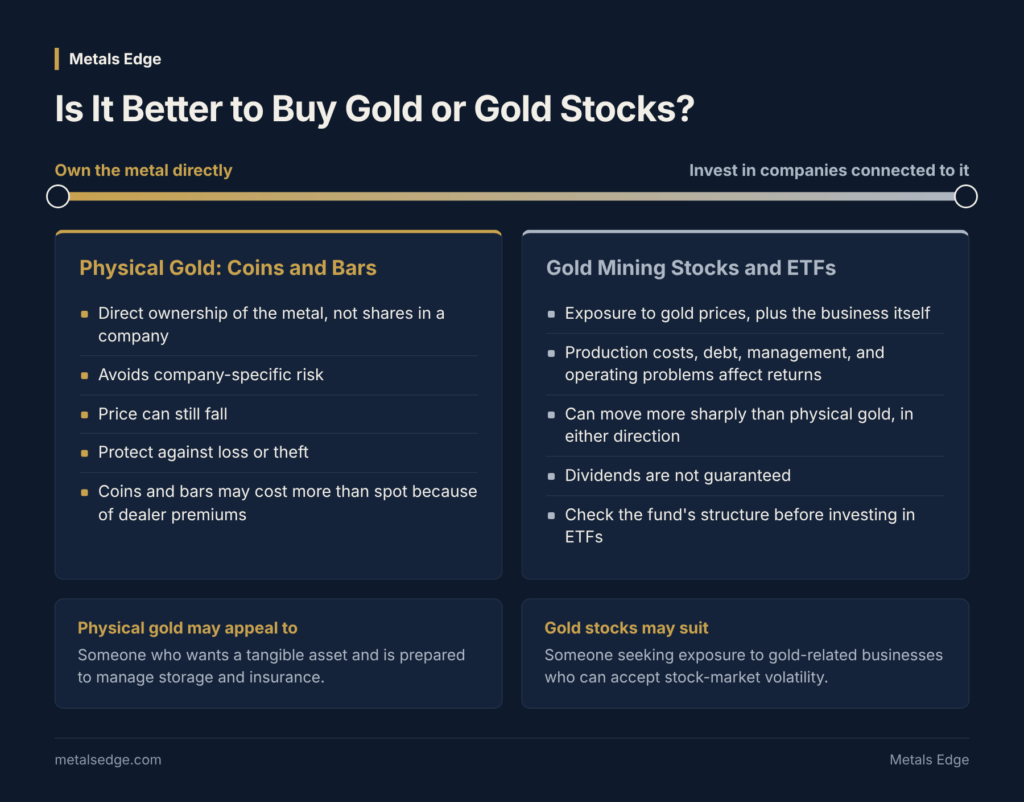
When deciding whether to buy gold or gold stocks, consider whether you want to own the metal directly or invest in companies connected to it.
Physical Gold: Coins and Bars
Physical gold gives you direct ownership of the metal rather than shares in a company. That avoids company-specific risk, but the gold price can still fall, and you must protect the asset against loss or theft.
Coins and bars may cost more than the spot price because of dealer premiums. Compare the total purchase cost, plan for secure storage, and choose a reputable dealer.
Gold Mining Stocks and ETFs
Gold mining stocks offer exposure to gold prices, but their performance also depends on the businesses involved. Production costs, debt, management decisions, and operating problems can affect returns, even when gold prices rise.
Mining stocks may move more sharply than physical gold in either direction. Some mining companies pay dividends, but those payments are not guaranteed. Gold-related ETFs also vary in what they hold and the risks they carry, so check the fund’s structure before investing.
Physical gold may appeal to someone who wants a tangible asset and is prepared to manage storage and insurance. Gold stocks may suit someone seeking exposure to gold-related businesses and who can accept stock-market volatility.
Which Fits Your Long-Term Goals?
Your time horizon, need for income, and comfort with risk can help guide the decision.
| Investor goal | How gold or stocks may fit |
| Long-term growth | Stocks may play a larger role, with gold used as a diversifier. |
| Portfolio diversification | Gold may complement stocks, though it can also lose value. |
| Interest in gold-related businesses | Mining stocks or ETFs provide market exposure, with business and investment risks. |
| Potential dividend income | Some stocks and funds pay dividends; physical gold does not. |
Many investors hold both rather than choosing only one. There is no single allocation that suits everyone. A financial advisor can help you consider a balance based on your circumstances and goals.
Smart Tips Before Buying Gold
Before adding physical gold to your portfolio:
- Compare the premium with the spot price. Check how much the dealer charges above the market price.
- Choose recognized products. Consider government-minted coins or bars from established refiners.
- Plan for storage and insurance. Decide how you’ll keep your gold secure and whether coverage is needed.
- Understand U.S. tax treatment. Physical gold is generally treated as a collectible for federal tax purposes. Rules depend on individual circumstances, so consult a qualified tax professional.
- Consider buying gradually. Spreading purchases over time may reduce pressure to pick one “right” moment, but it does not guarantee a profit.
For more information on choosing and purchasing precious metals, see our precious metals buyer’s guide.
FAQs
1. Is gold a better long-term investment than stocks?
It depends on your goal. Stocks are generally used for long-term growth, while gold may serve as a diversifier or potential store of value. Neither is guaranteed to perform well in every market.
2. Is it better for beginners to buy gold or gold stocks?
Physical gold means owning the metal directly, while gold stocks add company-specific risks. Mining shares can rise or fall for reasons beyond changes in gold prices.
3. Does gold rise when the stock market falls?
Sometimes, but not always. Gold may attract demand during market stress, though its price can also decline.
4. How much of my portfolio should be in gold?
There is no universal allocation. Some investors use gold as a diversifier, and a financial advisor can help assess what may fit your goals and risk tolerance.
5. Can physical gold be held in a retirement account?
Certain gold products may be held in a self-directed IRA if they meet IRS requirements and are held by an eligible trustee or custodian. Not every coin or bar qualifies.
6. What are the downsides of investing in gold?
Gold does not generate dividends or interest, and physical ownership may involve dealer premiums, storage and insurance costs. Its price can also decline or remain relatively flat for extended periods.
Gold or Stocks for Long-Term Wealth?
Stocks may be better suited to long-term growth, while gold may help diversify a portfolio. The choice depends on the role you want each asset to play, your time horizon, and your comfort with risk.
If you’re considering investing in gold vs. stocks, weigh those factors before deciding whether one or both belong in your portfolio.
Ready to explore physical gold? Read our precious metals buyer’s guide before making a purchase.