Gold vs. Silver vs. Platinum vs. Palladium: What Drives the Price of Each Metal?
The prices of precious metals do not always rise or fall together, which can catch new investors off guard. Gold, silver, platinum, and palladium each respond to different market conditions, including investor demand, industrial use, supply levels, and broader economic trends. As a result, one metal may gain value while another moves lower on the very same day.
Recent market activity offers a useful example. According to CME Group, gold moved above $4,500 an ounce in early 2026, while silver climbed beyond $80 per ounce and platinum reached its first record levels since 2007. These price movements show how differently individual metals can perform even within the same market cycle.
For buyers, recognizing these differences makes it easier to put daily price changes into context. The guide below compares gold, silver, platinum, and palladium, explains the factors behind their movements, and highlights where you can find current precious metal rates.
Why Precious Metals Prices Move Differently
The prices of precious metals respond to several shared forces, including supply and demand, U.S. dollar strength, inflation, interest rates, and geopolitical uncertainty. The difference is how heavily each metal responds to those factors.
Gold has a strong monetary and investment role, while silver combines monetary demand with major industrial consumption. Platinum and palladium lean more heavily toward industrial applications, particularly automotive manufacturing.
That distinction can create very different price reactions. A shift in Federal Reserve policy may quickly affect gold, while a change in vehicle production can have a stronger effect on palladium.
A precious metals value chart can make these differences easier to see. Comparing several metals across the same period can reveal whether a move is broad across the sector or tied to one metal’s specific supply or demand conditions.
Gold: The Safe-Haven Standard
In December 2025, more than 27% of 1,532 precious-metal investors surveyed by BullionVault said geopolitical tensions, including conflicts involving Russia, Ukraine, and the Middle East, along with U.S.-China tensions, would have the biggest influence on gold prices in 2026. That response highlights why gold can react so quickly when global uncertainty rises.
Gold has long attracted investors during periods of economic and political uncertainty. Its role as a hedge against inflation and currency weakness can increase demand when confidence in traditional currencies declines. Central banks add gold to their reserves, consumers purchase it as jewelry, and investors access it through physical bullion and exchange-traded funds.
The relationship between gold and two major economic indicators is also worth watching. Gold often moves in the opposite direction of the U.S. dollar and real interest rates. A stronger dollar or higher real rates can put pressure on gold, while a weaker dollar and lower real rates can support higher prices. For anyone checking the price of precious metals this week, these indicators offer useful context behind the daily movement.
Key Price Drivers for Gold
Central bank purchases and reserve policies
Inflation expectations and interest rate movements
Strength or weakness of the U.S. dollar
Investor activity and jewelry demand
Silver: Dual Personality of Money and Industry
Silver occupies a different position in the market because demand comes from both investors and manufacturers. The U.S. Geological Survey notes that silver is used in electronics, brazing alloys, solder, jewelry, coins, and other applications, which helps explain why industrial demand can affect silver prices.
Unlike gold, silver has a larger industrial role. That connection can make silver more responsive to changes in manufacturing activity, while its use as an investment gives it another source of demand.
Investors can purchase silver through bars, coins, and exchange-traded products. Since the silver market is smaller than the gold market, shifts in investment activity can also lead to more noticeable price swings. The gold-to-silver ratio provides another useful reference, showing how many ounces of silver would equal the value of one ounce of gold.
Together, industrial consumption, investor interest, mine production, and its relationship with gold can make precious metal rates for silver especially responsive to changing market conditions.
Key Price Drivers for Silver
Industrial and green-energy demand
Investment demand and market liquidity
Mining supply, which is frequently a byproduct of other metals
Platinum is rarer than gold and has a much stronger industrial identity. Its applications include automotive catalytic converters, petroleum refining, jewelry, electronics, and emerging hydrogen technologies.
Supply is also concentrated geographically. That makes disruptions at major mines or processing facilities capable of creating substantial price movements.
Automotive demand remains a major factor, although changes in engine technology are reshaping the market. Hydrogen fuel-cell development provides another potential source of demand, while platinum jewelry and investment products add additional buyers.
In 2025, Reuters reported that platinum prices rose 41% by June, supported by supply concerns, investor interest, and increased jewelry demand.
Key Price Drivers for Platinum
Concentrated mining supply and disruption risk
Automotive catalytic converter demand
Emerging hydrogen fuel-cell demand
Investment and jewelry demand
Palladium: The Industrial Wildcard
Palladium has one of the most concentrated demand profiles among major precious metals. Its biggest use has historically been in catalytic converters for gasoline-powered vehicles, where it helps reduce harmful emissions.
That dependence can create sharp price swings. When automotive demand rises while supply remains tight, palladium prices can jump quickly. When vehicle production weakens, or substitution toward platinum accelerates, the pressure can move in the opposite direction.
This history helps explain why someone checking the price of precious metals may see palladium move very differently from gold on the same day.
Key Price Drivers for Palladium
Tight supply from limited producing regions
Gasoline-engine catalytic converter demand
Substitution risk with platinum
EV adoption trends
Side-by-Side Comparison of the Four Metals
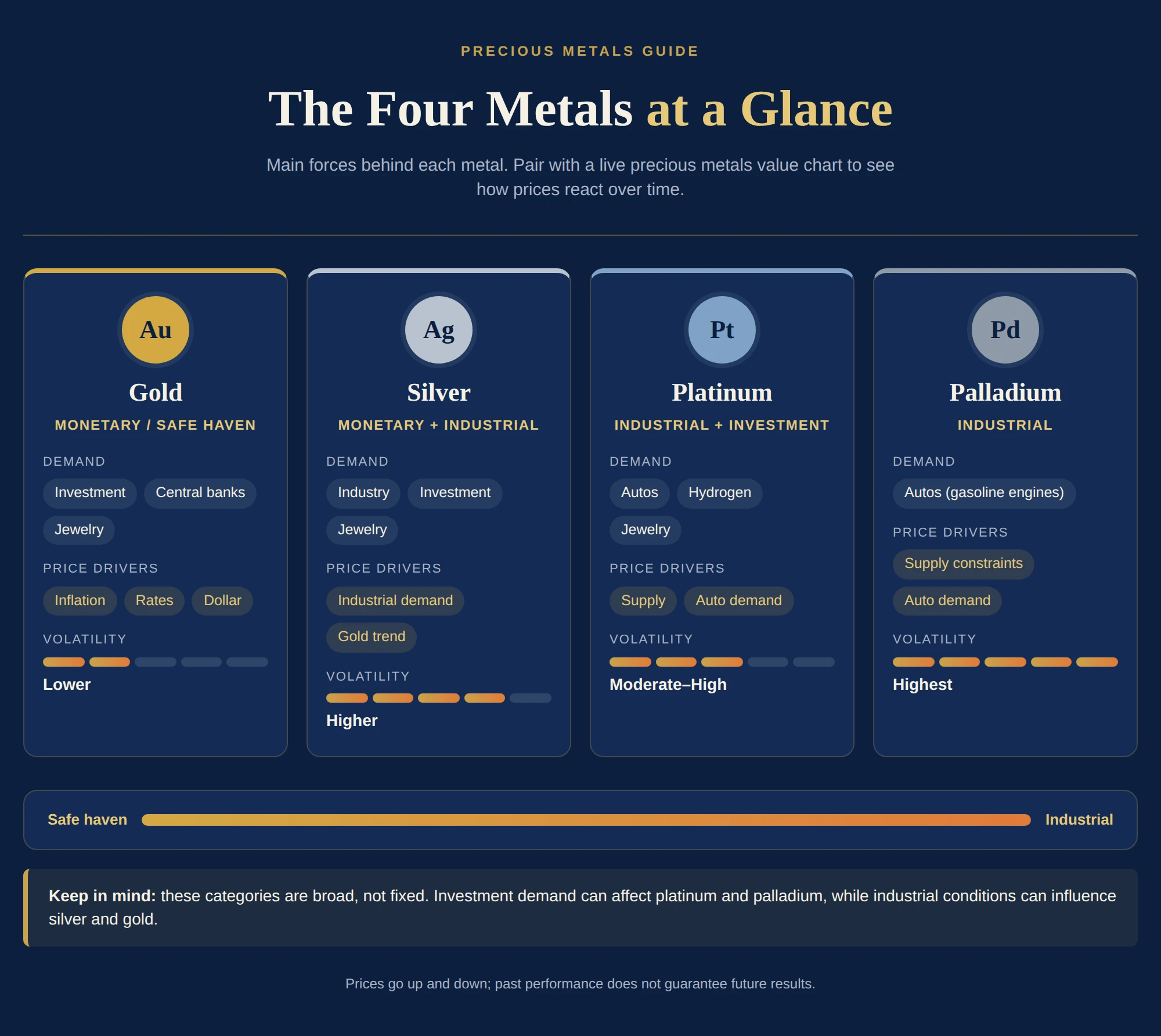
The table below provides a quick reference for the main forces behind each metal. Pairing it with a live precious metals value chart can give you a clearer picture of how prices react over different periods.
Metals
Primary Role
Main Demand Sources
Key Price Drivers
Relative Volatility
Gold
Monetary/safe haven
Investment, central banks, jewelry
Inflation, rates, dollar
Lower
Silver
Monetary + industrial
Industry, investment, jewelry
Industrial demand, gold trend
Higher
Platinum
Industrial + investment
Autos, hydrogen, jewelry
Supply, auto demand
Moderate–High
Palladium
Industrial
Autos (gasoline engines)
Supply constraints, auto demand
Highest
These categories are broad rather than fixed. For example, investment demand can affect platinum and palladium, while industrial conditions can influence silver and gold.
How to Track Live Precious Metals Prices
Checking real-time precious metal rates before you buy or sell protects you from stale numbers. Spot prices shift throughout the trading day, so the quote you saw this morning may not hold by afternoon.
A few habits help:
Use a precious metals value chart to compare short-term moves against long-term trends.
Watch market hours, breaking news, and currency shifts, since each can cause intraday movement.
Cross-check more than one source, because dealer premiums sit on top of the spot price.
Reliable tracking tools range from financial news sites to dedicated bullion dashboards that update live. Knowing the current prices of precious metals can give you better context before you buy or sell.
Frequently Asked Questions
1. What’s the price of precious metals today?
The price changes throughout the trading day. Gold, silver, platinum, and palladium each have their own spot prices, which are influenced by market trading, currency movements, economic data, and supply and demand. Feel free to check the live prices.
2. Which precious metal is the best investment?
There is no single answer for every investor. Gold may appeal to someone focused on monetary demand and diversification, while silver, platinum, or palladium may fit different views about industrial demand and supply.
3. Why is palladium sometimes more expensive than gold?
Palladium has traded above gold at points in the past when limited supply collided with strong automotive demand. Its concentrated supply base can create sharp price increases when available material becomes tight.
4. Do all precious metals move in the same direction?
No. Gold may rise because of safe-haven demand while palladium falls because of weaker automotive demand. Platinum and silver can also respond differently depending on industrial conditions and supply changes.
5. How often do precious metal rates change?
Precious metal rates can change continuously during active global markets. Currency movements, economic reports, central bank decisions, futures trading, and breaking news can all cause intraday price changes.
Next Steps to Compare Precious Metals With Us
The prices of precious metals are shaped by different forces, so looking at gold, silver, platinum, and palladium through the same lens can miss important market signals. Gold is closely linked to monetary conditions and investor demand, silver combines investment interest with industrial use, platinum serves several major industrial markets, and palladium remains strongly connected to gasoline-powered vehicles and emissions-control technology.
That makes current precious metal rates useful as a starting point, but the numbers become more meaningful when you know what is driving them. Metals Edge gives buyers and investors a convenient place to follow live precious metal prices, review market charts, and compare movements across major metals.
Whether you are researching your first purchase or reviewing an existing precious metals position, our team can help you keep market movements in context.
Schedule a consultation today.
Chris Thompson is a Research Contributor at Metals Edge, where he creates educational content on precious metals, sound money, macroeconomics, and long-term wealth preservation. With more than a decade of experience in the precious metals industry, he helps readers better understand the economic factors that influence gold and silver markets through clear, practical insights. Read Chris Thompson’s full author profile.
Get My Free 2027 Wealth Protection Guide Now!
We respect your privacy. Your data will not be shared or sold.
* By submitting the form above, you authorize Metals Edge or someone acting on its behalf to contact you for marketing & sales purposes. Message and Data rates may apply. Reply with STOP to opt-out.
Get Your Personalized Quote
We’ll get back to you within 1 business day.
Call 1-800-982-6105 for immediate assistance.
Speak with a specialist for price and availability